Unleashing the Dragon: The Art and Utility of the Horn Typeface
In the vast ecosystem of digital typography, few categories capture the imagination quite like display typefaces designed for high-fantasy narratives. While sans-serifs dominate the digital interface and serifs rule the printed novel, there exists a specialized niche for fonts that serve as both text and illustration. Enter Horn, a spectacular ornate dragon alphabet font that transcends mere communication to become a central piece of dark mythology artwork. This typeface is not merely a collection of glyphs; it is a meticulously crafted world of ancient magic, legendary beasts, and tactile history, designed to immerse an audience immediately into a narrative of epic proportions.
The Anatomy of Dark Mythology
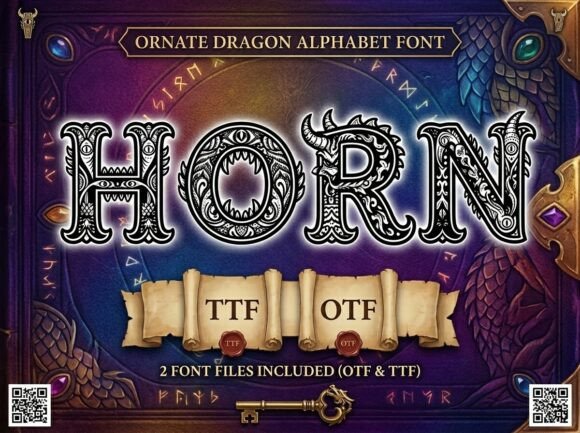
To understand the value of the Horn typeface, one must first examine its construction. At its core, Horn is a regular display typeface, but this description belies the complexity of its design. The foundation of each letter is built upon robust, classical Roman stems. This adherence to traditional Roman capital structures ensures that, despite the heavy ornamentation, the text remains legible and familiar to the human eye. The "bones" of the font are strong, providing a sense of stability and authority that is essential for headings and titles.
However, it is the "flesh" of the font that distinguishes Horn. The designers have intricately engraved these classical forms with elements of high-fantasy iconography. The serifs are not simple terminals; they are sculpted into the textures of dragon scales. The arches and counters of letters are not empty spaces but stages for slithering tail flourishes and fierce reptilian monster eyes that stare out from the core of the letter forms.
Furthermore, the structural elements of the alphabet feature beastly horned peaks, giving the typeface its namesake silhouette. These are not flat, two-dimensional vector shapes. Through deep structural shading and pristine outlines, Horn achieves an authentic, three-dimensional hand-carved look. The letters appear as if they have been chiseled into stone or carved into the wood of a ship sailing through treacherous, dragon-infested waters. This level of detail makes Horn a masterclass in vector illustration applied to typography.
Visual Psychology and Brand Atmosphere
The choice of typography is a psychological trigger for the viewer. When a consumer, reader, or player encounters the Horn typeface, specific associations are immediately activated. The interplay of the classical Roman structure and the aggressive, reptilian ornamentation signals a world where ancient history meets primal danger. This is the visual language of "Dark Fantasy"—a sub-genre that favors grit, texture, and high stakes over the whimsical or the sanitized.
For creators, using Horn is an act of world-building. It sets the tone before a single word of the body copy is read. It suggests that the content within is serious, heavy, and steeped in lore. The font acts as a filter, immediately drawing in the target audience—those who appreciate the aesthetics of the arcane and the monstrous—while establishing the setting as one of high fantasy epics. Whether the goal is to evoke the atmosphere of a tactical medieval game or the grandeur of a historical leather-bound codex, the typography serves as the atmosphere's anchor.
Strategic Applications in Modern Media
The utility of an ornate font like Horn extends across various industries, particularly where visual impact is synonymous with success. Its application is best understood by looking at specific use cases where its unique characteristics solve creative problems.
Tabletop Roleplaying and Gaming Interfaces
The tabletop roleplaying game (TTRPG) market is currently experiencing a renaissance. Game designers require assets that evoke the spirit of the game mechanics. Horn is an elite centerpiece for book headings in systems like Dungeons & Dragons or Pathfinder. In a tactical medieval game interface, where screen real estate is limited, the high legibility of the Roman stems combined with the thematic weight of the ornamentation makes it ideal for title screens, faction emblems, or item names. It provides the necessary "crunch" and texture that gamers expect from the fantasy genre.
Publishing and Novel Design
In the publishing world, the cover is the primary marketing tool. A fantasy novel cover must convey genre instantly. Horn excels here as a title font, creating a focal point that demands attention on both physical shelves and digital thumbnails. The "hand-carved" aesthetic pairs exceptionally well with cover art featuring oil painting styles or digital matte painting. Beyond the cover, the font can be used for chapter headings or drop caps within the interior layout to maintain the immersive experience of the mythical narrative.
Merchandise and Event Branding
The heavy metal and rock communities share a visual overlap with dark fantasy, often utilizing themes of mythology, monsters, and darkness. Horn is perfectly suited for heavy metal gig posters, where the aggressive reptilian eyes and horned peaks align with the genre's aesthetic. Additionally, for businesses selling historical leather-bound merchandise, cosplay accessories, or fantasy memorabilia, the font serves as a logo type that communicates craftsmanship and authenticity. It suggests that the product is not mass-produced, but rather a relic from a fantasy world.
Technical Considerations for Designers
While Horn offers immense visual rewards, its application requires a thoughtful approach to design principles. As a display typeface, it is not intended for body text. Using such a detailed font for long paragraphs would result in visual fatigue and poor readability.
Designers should focus on contrast and hierarchy. Horn works best when paired with a clean, neutral serif or sans-serif font for the body copy. This contrast allows the ornate details of the display font to shine without competing with the message of the main text. Furthermore, due to the intricate scale textures and shading, the font requires sufficient size to be appreciated. At very small sizes, the details may become muddy or lost. Therefore, it is best utilized for large headings, logos, and standalone artistic elements where the "beastly" details can be rendered clearly.
The Enduring Appeal of the Ornate
In an era increasingly dominated by flat design and minimalist interfaces, the persistence of ornate, detailed typography like Horn speaks to a human desire for richness and narrative depth. We are drawn to textures that mimic the real world—the roughness of stone, the sheen of a dragon scale, the depth of a carved groove.
Horn satisfies this desire by offering a bridge between the digital and the tactile. It provides a tool for creators to build worlds that feel lived-in, ancient, and dangerous. By mastering the balance between classical legibility and monstrous fantasy art, this typeface remains a vital resource for anyone looking to craft a narrative of high-stakes adventure and dark mythology. Whether for a game, a book, or a poster, Horn does not just spell out words; it sculpts them into legends.