Heat Road: Capturing the Thrill of Speed in Every Letter
There’s a specific kind of energy you feel when you see a racing stripe on a car or the jagged typography on a heavy metal album cover. It’s raw, fast, and undeniably aggressive. If you are working on a design project that needs to scream "action," you likely know that standard sans-serif fonts just won't cut it. You need something that feels like it’s moving even when standing still. Enter Heat Road, a display typeface that doesn't just sit on the page—it burns through it.
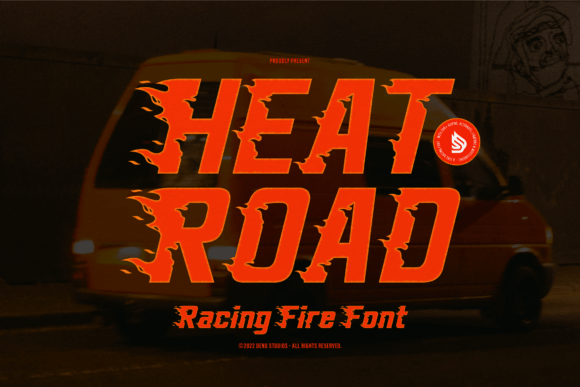
At its core, Heat Road is a fire-themed display font designed for maximum impact. But to say it is just a "fire font" is to sell it short. It is a typographic tool engineered for high-speed contexts. The letterforms feature jagged edges, dynamic angles, and visual textures that mimic the look of scorching heat and velocity. It is the visual equivalent of a revving engine or a sudden burst of adrenaline. For designers working in the sports, automotive, or entertainment industries, this font offers a ready-made solution for capturing intensity without needing complex illustration.
Where Rubber Meets the Road: Real-World Applications
The most obvious home for Heat Road is anywhere you find speed. Think about the branding for a local drag racing league or a custom motorcycle shop. The font’s aggressive styling immediately establishes the tone of the business. It tells the customer, "We deal in power and performance." You can see it working beautifully on the side of a race trailer, the header of a motorsport website, or the title card for a YouTube video review of a new sports car.
However, the utility of Heat Road extends beyond the asphalt. Consider the world of esports and gaming. In the digital arena, branding needs to be loud and competitive. A gaming clan looking to create a logo or a streamer designing overlays for a first-person shooter game would find Heat Road incredibly useful. The font’s texture adds a layer of grit and realism that flat, geometric fonts often lack. It helps bridge the gap between the digital world and the visceral feeling of high-stakes competition.
Event Branding and Merchandise
Imagine you are organizing a charity 5K run with an "extreme" obstacle course theme, or perhaps a summer music festival focused on rock and metal. The promotional materials need to convey excitement. Heat Road is perfect for event posters, wristbands, and merchandise. Because the font is so bold, it works exceptionally well on T-shirts and hats. It doesn't need a complex background to stand out; the typography itself becomes the graphic element. This is a massive advantage for merchandise where printing costs are often calculated by the number of colors or complexity of the design.
The Psychology of Aggressive Typography
Why does a font like Heat Road work so well for certain audiences? It comes down to psychology and association. Adults aged 20 to 50 who are interested in sports, action movies, or automotive culture are conditioned to associate sharp, angular shapes with speed and danger. When you use Heat Road on a poster for a monster truck rally, you aren't just spelling out the time and date; you are visually reinforcing the experience the audience is paying for.
For a designer, this is a shortcut to emotional resonance. Instead of spending hours trying to create a custom distressed texture or a hand-lettered logo that looks "tough," Heat Road provides that aesthetic out of the box. It allows you to focus on layout and color theory because the font has already done the heavy lifting regarding mood.
Practical Scenarios: Who Benefits Most?
Different users will find value in Heat Road for distinct reasons. Understanding these scenarios can help you decide if it’s the right fit for your toolkit.
- Small Business Owners in the Automotive Sector: If you run a garage, a tire shop, or a detailing service, your logo is often the first impression you make. Heat Road gives you a professional yet high-energy look that suggests expertise with high-performance vehicles. It pairs well with metallic textures and neon color palettes.
- Social Media Managers: In the fast-paced scroll of Instagram or TikTok, you have milliseconds to grab attention. Using Heat Road for text overlays on video thumbnails or sale announcements can stop the scroll. Its distinct silhouette is recognizable even at small sizes on a mobile screen, provided the contrast is high.
- Book and Album Cover Designers: Whether you are designing a cover for a thriller novel or an indie rock album, the genre dictates the font. Heat Road fits perfectly into the "grunge" or "action" aesthetic. It provides that necessary visual shorthand that tells the consumer exactly what kind of content to expect inside.
Considerations Before You Apply the Heat
While Heat Road is a powerful tool, it requires a specific touch. Using a display font effectively is about knowing when to use it and, more importantly, when not to use it.
Readability vs. Style
The primary limitation of a highly stylized font like Heat Road is readability in long-form text. This is not a font for body copy. If you try to write a paragraph explaining your return policy in Heat Road, your customers will likely leave your site with a headache. The jagged edges and complex shapes are designed for headlines, logos, and short bursts of text. Always pair it with a clean, neutral sans-serif or serif font for the supporting text to create a balanced hierarchy.
Context is King
You must match the font to the subject matter. Using Heat Road for a wedding invitation or a daycare center brochure would be a jarring mismatch. The "fire" aesthetic implies heat, danger, and intensity. It works for a BBQ sauce label or a gym advertisement, but it can feel aggressive or out of place in contexts requiring softness or formal elegance.
Color and Contrast
Because the font has a lot of character, the colors you use will drastically change the outcome. High-contrast combinations—like white text on a black background or yellow on red—amplify the energy. Muted earth tones can make the font feel more vintage or "garage rock." Experimentation is key. Since the font mimics flames, colors like orange, red, and electric blue often yield the most cohesive results, but a metallic chrome effect can also look stunning for automotive projects.
Integrating Heat Road into Your Workflow
When you sit down to design with Heat Road, think about the composition. The font has a lot of "texture" built-in, so you don't necessarily need to overlay it on a busy photograph. Sometimes, letting the text stand alone against a solid color or a subtle grunge texture allows the letterforms to shine without creating visual clutter.
Furthermore, consider the spacing. Display fonts with jagged edges often benefit from slightly tighter tracking (letter spacing) to make the words feel like a cohesive unit rather than a collection of separate spikes. However, be careful not to let the letters crash into one another, which can happen with italicized or script-style display fonts. Test it at the size it will be viewed; a font that looks like a blur on a billboard might look perfect on a business card.
Ultimately, Heat Road is about attitude. It is for the projects that need to feel fast, loud, and alive. Whether you are branding a race team, designing a flyer for a stunt show, or creating a logo for a new energy drink, this font provides the visual horsepower to get the job done. It captures the essence of the road and the heat of the moment, turning ordinary text into a statement.