A Balanced Look at Tranquilo Monoline Boho: Evaluating Its Place in Modern Design
In the vast landscape of typography, finding a font that balances minimalism with character can be a significant challenge. Designers often seek typefaces that are clean and legible but also possess a unique flair that sets a brand apart. Tranquilo Monoline Boho enters this conversation as a distinct option, presenting itself as a luxurious duo font. It is designed to merge the crispness of a sans-serif with the fluidity of a script, aiming for a sophisticated yet accessible aesthetic. Understanding where it fits requires a closer look at its construction, its intended applications, and how it compares to other design approaches.
Understanding the Core Composition
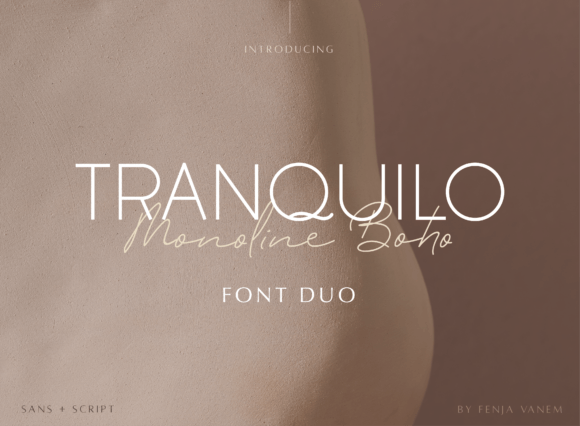
At its heart, Tranquilo Monoline Boho is a pairing system. It consists of two complementary typefaces designed to work in harmony. The primary component is a sleek, modern sans-serif. This element provides the structural foundation, ensuring readability and a clean visual hierarchy. The secondary component is an elegant, monoline script. "Monoline" indicates that the strokes of the letters maintain a consistent thickness, which often results in a more contemporary and less formal script style compared to traditional calligraphy fonts with thick and thin variations.
The "Boho" aspect of the name suggests an influence from bohemian aesthetics—often characterized by a free-spirited, artistic, and slightly unconventional feel. In practice, this translates to the script having a relaxed, hand-lettered quality. It avoids the rigidity of technical scripts while steering clear of overly ornate or vintage styles. The combination is intended to evoke a sense of effortless luxury, where the design feels both polished and personal.
Key Strengths and Practical Applications
The primary strength of Tranquilo Monoline Boho lies in its versatility as a system. Because the sans-serif and script are designed as a pair, they share underlying proportions and stylistic nuances. This removes much of the guesswork involved in pairing separate fonts from different foundries, which can sometimes result in a visual clash.
This font duo is particularly well-suited for several specific use cases:
- Branding and Identity: For businesses in the lifestyle, beauty, wellness, or boutique retail sectors, the font can create a brand identity that feels both professional and approachable. The sans-serif works well for body copy and straightforward information, while the script can highlight brand names, taglines, or special offers.
- Editorial Design: In magazines, lookbooks, or blog graphics, the combination allows for dynamic layouts. A headline in the elegant script can draw the eye, followed by clean sans-serif text for readability.
- High-End Product Packaging: The luxurious feel of the letterforms can enhance the perceived value of products. It communicates care and attention to detail, which is crucial for premium goods.
- Wedding and Event Stationery: The relaxed elegance of the script makes it a natural fit for invitations, menus, and programs, while the sans-serif ensures practical details remain legible.
A notable technical feature is its PUA (Private Use Areas) encoding. This means that special characters, swashes, and alternate glyphs are accessible via standard keyboard shortcuts or character maps in most design software, without requiring advanced OpenType feature support. For designers who may not be working in environments with full OpenType capabilities, this can simplify the process of using decorative elements.
Evaluating Tradeoffs and Considerations
No typeface is universally perfect, and Tranquilo Monoline Boho is no exception. Its stylistic strengths can also present limitations in certain contexts. The monoline nature of the script, while modern and clean, may lack the dynamic contrast that some designers seek for ultra-formal or highly traditional applications. A project requiring the gravitas of a classic copperplate script or the sharpness of a traditional serif might find this font too casual.
Furthermore, the "Boho" aesthetic, while popular, is a distinct stylistic direction. It aligns perfectly with certain brand personalities but could feel incongruent with others. For example, a law firm, a financial institution, or a tech company focused on stark, futuristic minimalism might find the artistic flair of the script at odds with their desired image. In such cases, a more neutral sans-serif paired with a simpler, more formal script or no script at all would be a more appropriate choice.
Another consideration is overuse. Because font duos are designed for cohesion, there is a risk of designs looking similar if many brands in the same niche adopt the same popular pairings. Designers must use the font's alternates and swashes creatively, and pair it with unique color palettes, imagery, and layouts to maintain a distinctive brand presence.
How It Compares to Other Approaches
When evaluating Tranquilo Monoline Boho, it's helpful to consider the broader categories of alternatives.
Using Two Separate, Unmatched Fonts: This is the most common approach. The advantage is infinite customization; you can find a perfect sans-serif and a perfect script from anywhere. The disadvantage is the time and skill required to ensure they work well together in terms of weight, x-height, and overall mood. Tranquilo Monoline Boho solves this pairing problem out of the box.
Using a Single, Versatile Type Family: Many modern font families (like those with extensive weights and optical sizes) can carry an entire design. This approach prioritizes unity and simplicity. It is often more legible for dense text but may lack the expressive contrast of a duo system for headlines and accents.
Using a Different Style of Font Duo: Other duos might pair a serif with a sans-serif, a slab serif with a script, or two contrasting sans-serifs. The choice depends on the desired emotional tone. A serif/sans-serif duo might feel more traditional and authoritative, while Tranquilo Monoline Boho specifically targets a modern, luxurious, and slightly organic feel.
Is Tranquilo Monoline Boho the Right Choice?
Determining if this font is the right fit involves aligning its characteristics with your project's goals and audience.
It may be an excellent choice if:
- Your brand or project embodies values of effortless elegance, creativity, modern luxury, or personal touch.
- You need a ready-made, cohesive typographic system that saves time on pairing.
- Your audience responds to designs that feel both polished and artisanal.
- You work in an environment where accessing OpenType alternates via PUA encoding is preferable.
You might need to look elsewhere if:
- The required tone is strictly corporate, hyper-technical, or traditionally formal.
- Your project demands a typeface with extreme versatility for long-form reading, where a dedicated text family would be superior.
- You anticipate the need for a very large family of weights and widths for complex responsive design systems.
- You seek a completely unique, custom lettering style that no pre-made font can provide.
Ultimately, Tranquilo Monoline Boho is a specialized tool. Its value lies in its ability to deliver a specific, desirable aesthetic efficiently. By understanding its design intent, its strengths in pairing and stylistic cohesion, and its limitations in context, you can make an informed decision. It represents one compelling answer to the ongoing search for typography that is both minimal and luxurious, practical and full of character. For many branding and design projects, particularly in the lifestyle and boutique sectors, it offers a refined and effective solution worth serious consideration.